

Picture a Monday morning. Forty customers call within five minutes, three agents pick up, and everyone else sits through and holds music while their patience thins. Phone support remains the channel people trust when something matters, and it is also the costliest one to run.
You do not have to choose between a basic phone menu and a fully automated assistant. Combining IVR and Voice AI agents for cost effective support lets the IVR greet, verify, and route each caller, lets the Voice AI agent finish routine requests in one conversation, and keeps your people free for calls that truly need a human. This guide explains what each tool does, how to connect them in four steps, where the savings come from, and what setup costs.
What Is IVR, and Where Does It Fall Short?
IVR stands for interactive voice response. It is the system that greets a caller and offers options such as press 1 for billing or press 2 for technical help. Newer versions accept spoken answers through speech recognition, but the logic underneath stays fixed. Every path is written in advance.
That is both its strength and its weakness. A scripted menu is predictable, easy to audit, and cheap to run. It also falls apart when a caller asks something the menu never planned for. Long option lists and dead ends push people to mash zero, the shortcut to a person.
Demand has not faded. Mordor Intelligence sizes the market at USD 5.39 billion in 2025 and forecasts USD 7.07 billion by 2030, a growth rate of 5.56% a year. The same report notes that cloud deployments held 62.48% of the market in 2024.
What Are Voice AI Agents?
A Voice AI agent is software that holds a spoken conversation. It listens to the caller through speech recognition, works out intent with natural language understanding, and then acts by reading or updating your CRM, billing, or booking system. Ask where your refund is and it looks up the record and tells you. No menu tree needed.
The money is following the technology. Grand View Research figures, compiled by RaftLabs, put AI voice agents at USD 2.54 billion in 2025 and USD 35.2 billion by 2033, a 39.0% annual growth rate. The broader conversational AI market is projected to climb from USD 11.58 billion in 2024 to USD 41.39 billion by 2030, growing 23.7% a year.
Why the Pair Beats Either Tool Alone
Labor is the biggest line on a support budget. Gartner analyst Daniel O'Connell has said labor can reach up to 95% of contact center costs, and Gartner forecast that conversational AI would trim USD 80 billion from agent labor costs in 2026.
Channel price gaps explain why. A 2019 Gartner poll found that live channels cost about $8.01 per contact, while self service cost about $0.10. Those figures are older and your own numbers will differ, but the gap is the point. Every call that never reaches a person is cheap.
Here is the catch. The same Gartner release reports that only 9% of customers solved their issue fully through self service, and the rest turned to a live call. Rigid design leaks cost. A menu alone sends too many callers to agents, while an AI agent alone can feel like a gamble on urgent or sensitive calls. Together, the menu gives you control and the agent gives you flexibility.
How to Combine Them: A Step by Step Plan
Step 1: Let IVR Greet, Verify, and Route
Keep the phone menu as the front door. Use it for language choice, caller verification, and urgent flags such as an outage or suspected fraud. Limit it to three options and add an open prompt asking why the person is calling. Good call routing at this stage decides who needs which resource.
Step 2: Hand Routine Requests to the Voice Agent
Order status, password resets, appointment changes, balance checks, and billing questions make up a large share of volume for many teams. Train the agent on these first. Intent detection sorts the request, and the agent finishes the job in one conversation. This is call deflection that callers actually like, because they get an answer instead of another menu.
Step 3: Escalate With Full Context
When the caller sounds frustrated, asks for a person, or raises something complex, transfer the call with a transcript and a short summary. Nobody repeats their story. Gartner notes that gathering details with AI at the start of a call can cut up to a third of the time a human spends on it, which shortens average handling time.
Step 4: Review Weekly and Improve
Read the failed calls. Find the ten most common reasons the agent handed off, then fix the content or the system connection behind each one. Track containment rate, first call resolution, and cost per contact so progress shows up in numbers, not feelings.
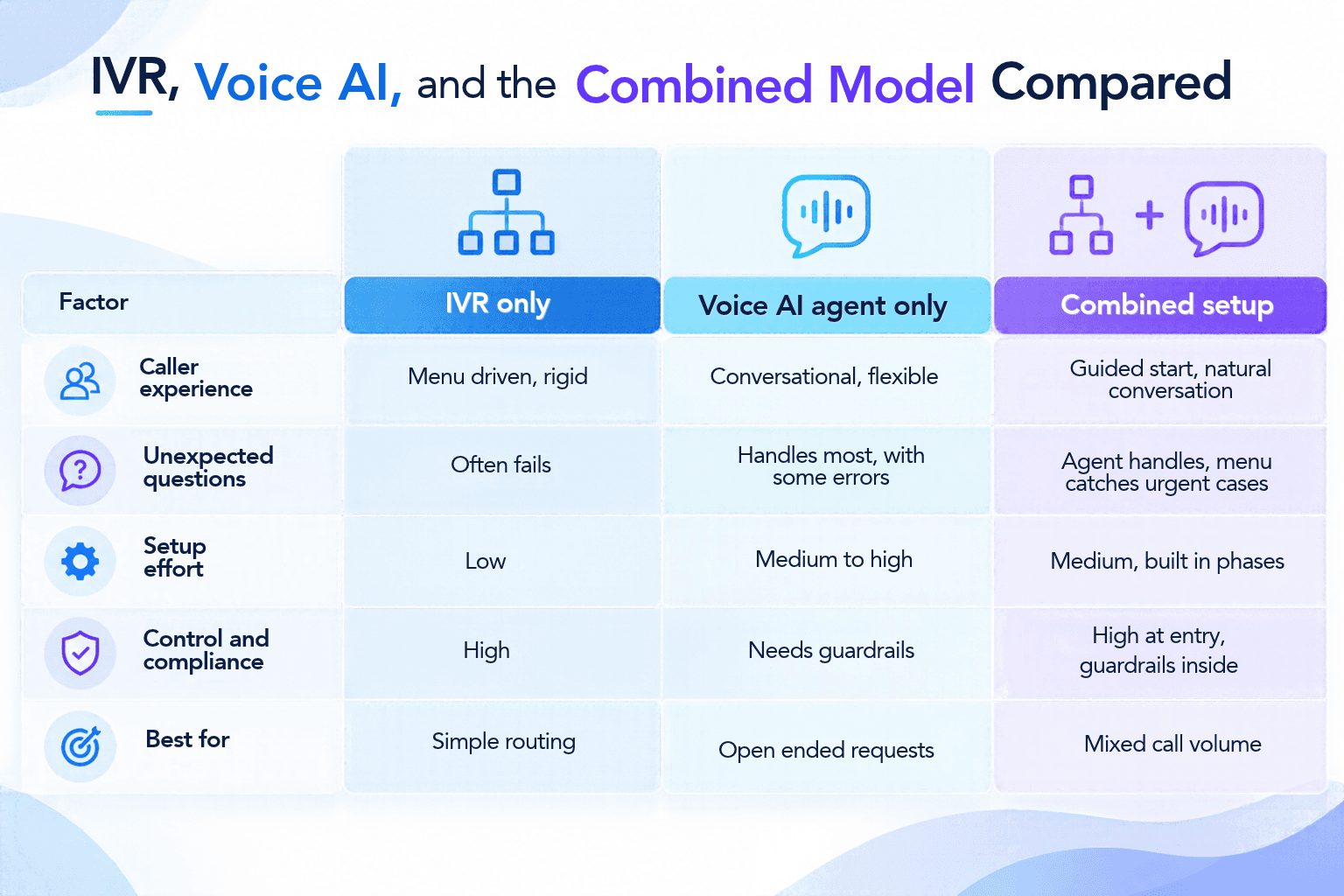
IVR, Voice AI, and the Combined Model Compared
Where the Savings Actually Come From
- Fewer live minutes: routine calls end without an agent, and escalated calls arrive prepared.
- Round the clock coverage: 24/7 availability without paying for night shifts.
- Calmer peak hours: automated handling absorbs spikes instead of stretching queues.
- Cleaner data: every call becomes searchable text that shows what customers really ask.
Lower LLM token costs
The pairing also helps control LLM token cost, which is a growing challenge for enterprises as AI usage scales. Voice AI agents built on large language models are billed by tokens, and each turn of a call re-sends the instructions and the conversation so far, so long, open-ended calls get expensive.
When the IVR handles greeting, language choice, verification, and routing with fixed logic, those steps use no LLM tokens at all, and the agent starts every call already scoped to a single intent with a shorter prompt. Fewer turns, a smaller context, and a human handoff for complex calls keep token usage, and the bill, more predictable. Speech recognition and voice output are usually priced separately, so track them next to your token spend.
What Comes Next
Gartner predicts that by 2029 agentic AI will independently resolve 80% of common customer service issues, cutting operational costs by 30%. Teams that build the base now, a clean menu, connected systems, and trained agents, will be ready when that shift arrives. Complex and emotional calls will still need human judgment, which is why handoff design matters. Clara AI is built on this same belief: automate the routine, and hand off to a human when it counts.
Final Thoughts
IVR gives your phone line structure. Voice AI agents give it a voice that listens. Used together, they cut the cost of every routine call while protecting the quality of the hard ones. Start with one call type this month, measure honestly, and let the results decide your next step.
FAQs
Will Voice AI replace my IVR?
Not completely. The menu still handles verification, urgent flags, and compliance prompts. The Voice AI agent takes over the open conversation.
Can a small business afford this?
Yes, if you begin small. Pick one high volume request, automate it, and measure the drop in live calls before adding more.
Which metrics prove it works?
Watch containment rate, first call resolution, average handle time, cost per contact, and customer satisfaction. Compare each against your numbers from before launch.
Is caller data safe?
It can be, with the right controls. Use encryption, clear consent prompts, and follow the data protection rules that apply to you, such as GDPR or India's DPDP Act.