


You can walk onto almost any call center floor and you will surely notice something: half the faces weren't there six months ago. That's not an exaggeration, it's the industry's reality. Call center agent attrition now runs between 40% and 45% a year across the world, and in some high-pressure operations it climbs past 55%.
If you run or manage a contact center, you already feel this in your budget, your training calendar, and your customer satisfaction scores.
Resource attrition has become the industry's costliest problem. Quietly draining budgets already stretched thin finance. AI platforms like Clara AI are changing the math, not by replacing your existing team, but by lifting the repetitive load off their shoulders
What Is Call Center Agent Attrition, and Why Does It Keep Rising?
Agent attrition rate is simply the rate at which employees leave a call center role within a given period, whether by resignation, termination, or transfer. Moreover, it is tracked as a core KPI because unlike most attrition metrics in other industries, contact center turnover is brutally high by default.
Here's the scale of it, based on recent industry benchmarking:
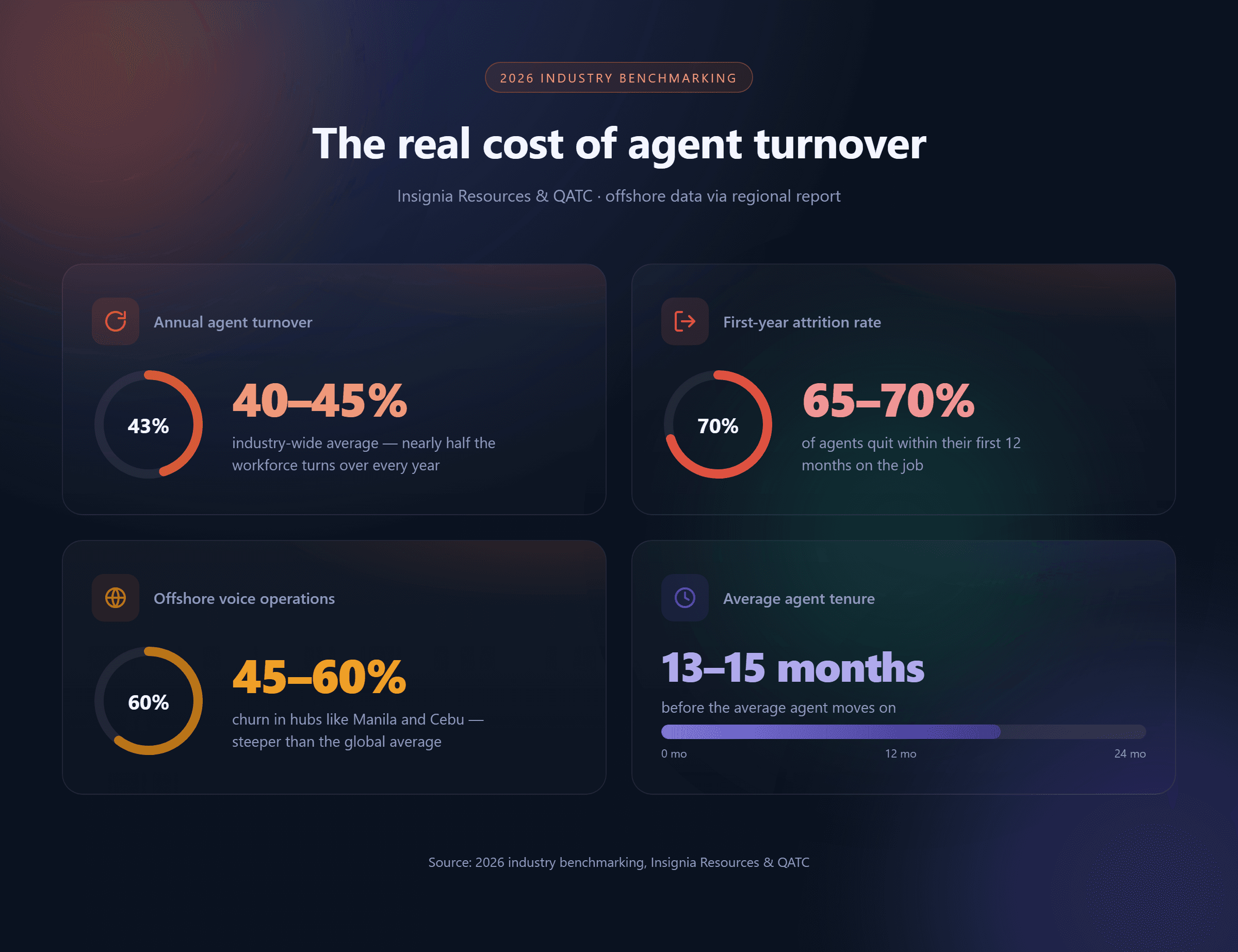
Why is the attraction too high rather than settling down in a once lucrative job market preferred by many skilled resources? A few factors are compounding at once.
- Call volumes remain unpredictable,
- Wage growth in adjacent industries makes call center pay look less competitive, and, perhaps most tellingly - the calls that reach a live agent today are the harder ones.
- Chatbots and IVRs already absorb the simple password resets and balance checks and chipping away most of the agent’s work. So now one question always lingers in the minds of call center agent’s: What's left for humans requires more judgment, more patience, and more emotional bandwidth, which speeds up burnout.
The Real Cost of Agent Turnover
Losing an agent isn't just an HR headache. It's a direct hit to your operating budget, and the number is bigger than most leaders assume.
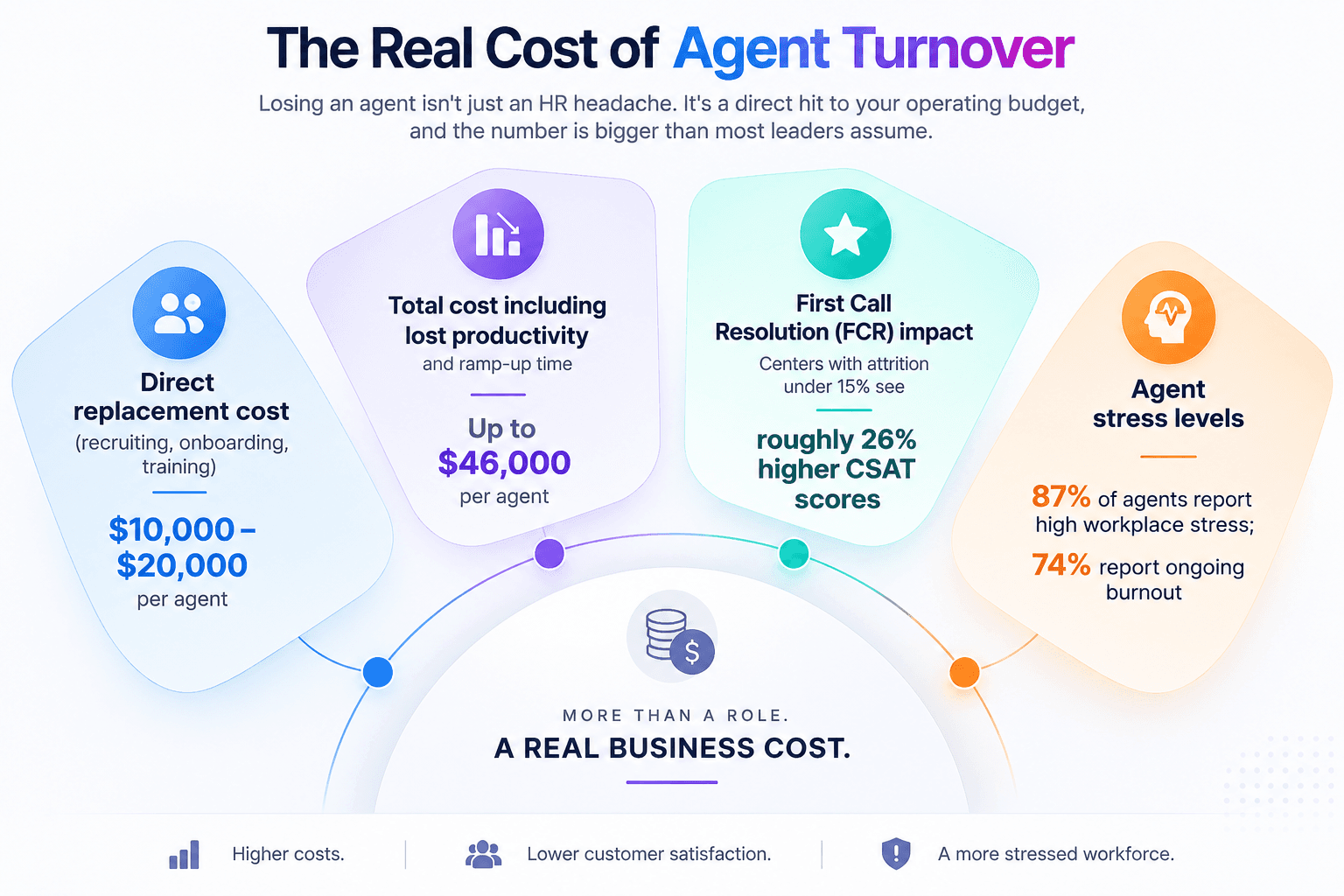
Run the math on a 100-agent floor with a typical 40% turnover rate, and you are looking at $400,000 to $800,000 a year spent purely on backfilling seats even before you count the dip in service quality while new hires ramp up.
Why Do Call Center Agents Quit?
Ask any workforce manager and you'll hear a familiar list. Ask the agents themselves, and the pattern gets even clearer:
- High call volume and repetitive work
- Poor management and lack of career progression
- Burnout from inconsistent schedules,
- Compensation that hasn't kept pace with the cost of living
- Limited recognition or growth path
Traditional Fixes vs. an AI-Powered Approach
Most contact centers have tried the conventional playbook: better pay, better shifts, more perks, more coaching. These help at the margins, but they don't touch the root problem too much repetitive, low-judgment work landing on human agents.
| Approach | What It Solves | What It Misses |
|---|---|---|
| Higher pay & bonuses | Short-term retention bump | Doesn't reduce workload or burnout |
| More supervisors & coaching | Better quality monitoring | Adds cost without reducing call volume |
| Outsourcing to lower-cost regions | Lower wage bill | Attrition often higher offshore, not lower |
| AI agent platform (e.g., Clara AI) | Absorbs repetitive volume, cuts burnout, keeps senior agents on complex work | Requires initial setup and knowledge base training |
This is where AI customer service agents earn their place not as a replacement narrative, but as a genuine fix for the workload problem driving attrition in the first place.
How Clara AI Reduces Dependency on Hiring & Retraining
Clara AI is built around one core idea: let AI absorb the volume that burns agents out, and let humans handle the conversations that actually need a human.
Here's what that looks like in practice.
One Platform Across Every Channel
Clara answers calls, responds on WhatsApp, and handles email all using the same underlying knowledge base and business rules. Instead of running separate teams (or separate outsourcing contracts) for each channel, one AI layer covers the load 24×7, including weekends and holidays when staffing is hardest to cover.
No-Code Agent Configuration
AI Agent Studio helps teams to shape their AI agent's persona, guardrails, and business logic with no coding needed. Ops teams can update it as policies change, without the retraining cycle new hires require.
Zero Call drop
Call centers often drop calls when every agent is busy, which leaves customers frustrated and forces them to call back. Clara AI removes this problem because it can handle calls without limits on availability. There are no queues and no busy signals, so every call gets answered as soon as it comes in.
Grounded, Knowledge-Based Responses
Every answer Clara gives is grounded in your approved documents and business knowledge, not open-ended generation. This keeps responses consistent even during peak volume, something new hires typically take months to master.
AI + Human Collaboration, Not AI vs. Human
When a conversation genuinely needs a person, Clara hands it over with full context and a conversation summary. Agents stop hearing "the customer already explained this twice" a small detail that makes a real dent in agent frustration and, by extension, attrition.
Self-Improving Knowledge Base
Clara AI identifies gaps in its own knowledge and drafts improvements over time. That means the platform gets sharper the longer it runs, instead of degrading the way service quality often does when experienced agents leave and new ones start from zero.
Built-In Compliance and Audit Trail
All conversions are recorded with factors like sentiment, intent, and resolution which are tracked automatically without hesitation for regulated industry niches like banking, lending, and healthcare.
Real Impact: What Changes When AI Joins the Floor
The broader market data is nothing but a showcase of exactly what shifts look like. The global voice AI market crossed roughly $22 billion in 2026 and continues to grow at a compound rate near 35% a year, and Gartner projects that conversational AI will cut contact center labor costs by an estimated $80 billion globally in 2026 alone.
Separately, the contact center AI market itself valued at roughly $2 billion in 2024 is projected to reach over $7 billion by 2030.
The reason this money is moving, it’s not just hype its math. When routine, high-volume interactions shift to AI, three things tend to happen at once:-
- Human agents handle fewer, higher-value conversations
- After-hours and peak-volume coverage stops depending on overtime or emergency staffing.
- New hires ramp up faster - AI handles the routine cases while they build confidence on complex issues.
Bottom Line-
You cannot out-recruit attrition. It's not a hiring problem, it's a workload problem, and it needs a workload fix.
Clara AI takes the repetitive, round-the-clock grind off your team's plate, so the agents you fought hard to train and keep get to spend their day on work that actually needs a human brain, where Clara AI is a perfect fit.
If you are stuck in the hire-train-lose loop, maybe it's time to stop feeding the cycle,and see what happens when the workload actually gets redistributed.