

Every contact center leader eventually hits the same wall, call volumes to keep climbing, agent turnover stays high, and the board wants an automation plan that works, not another IVR menu customers hate. The real question is not whether to automate.
It is which technology to automate with a classic IVR, a text-based chatbot, or an AI voice agent. Each one solves a different problem, and picking the wrong one is expensive to walk back. This guide breaks the choice down in plain terms, with the data behind it.
What These Three Systems Actually Do
Before comparing anything, it helps to be clear on definitions, because these terms get used loosely in vendor pitches.
IVR (Interactive Voice Response) is the oldest of the three. A caller listens to a recorded menu and presses buttons or says a short word to get routed somewhere. It does not understand language. It matches inputs to a fixed menu tree.
Chatbot is a text-based assistant, usually on a website or app, that answers questions using scripted flows or a language model. It reads and writes texts. It does not handle phone calls on its own.
AI voice agent is a newer category. It listens to natural speech, understands intent the way a person would, reasons about what the caller needs, and can take real action in business systems such as a CRM or core banking platform, not just route the call, a truly AI customer service agent.
The distinction that matters most for leaders is this: An IVR follows a tree, a chatbot follows a script or a model limited to text, and an AI voice agent follows the conversation.
Why This Decision Matters Right Now
This is not a theoretical debate. According to Grand View Research, the global call center AI market was valued at roughly 2.9 billion dollars (about $8.9 per person in the US) in 2026 and is projected to reach 7.1 billion dollars (about $22 per person in the US) by 2030, growing at a compound annual growth rate of 23.8 percent. That is a market more than doubling in under five years, driven largely by voice, not text.
Customer patience with old style automation is running out too. Research cited by Assembled found that 88 percent of customers still prefer a real person over a phone menu, and 61 percent call IVR a poor experience.
A McKinsey survey found seven in ten companies report IVR containment, the share of calls resolved without a transfer, at 30 percent or lower.
The upside is real. The same research found 65 percent of customers say voice AI actually improves their phone experience when it is done well.
Step by Step: How to Evaluate the Right Fit
Step 1: Map your channel mix - List where customers reach you: phone, web chat, app, WhatsApp. A pure phone operation needs voice first automation. A digital heavy operation may lean chatbot.
Step 2: Classify your call types by complexity - Simple, repeatable requests such as balance checks or order status suit any of the three. Multi steps, judgement heavy requests such as a dispute or a hardship case need reasoning, which rules out basic IVR entirely.
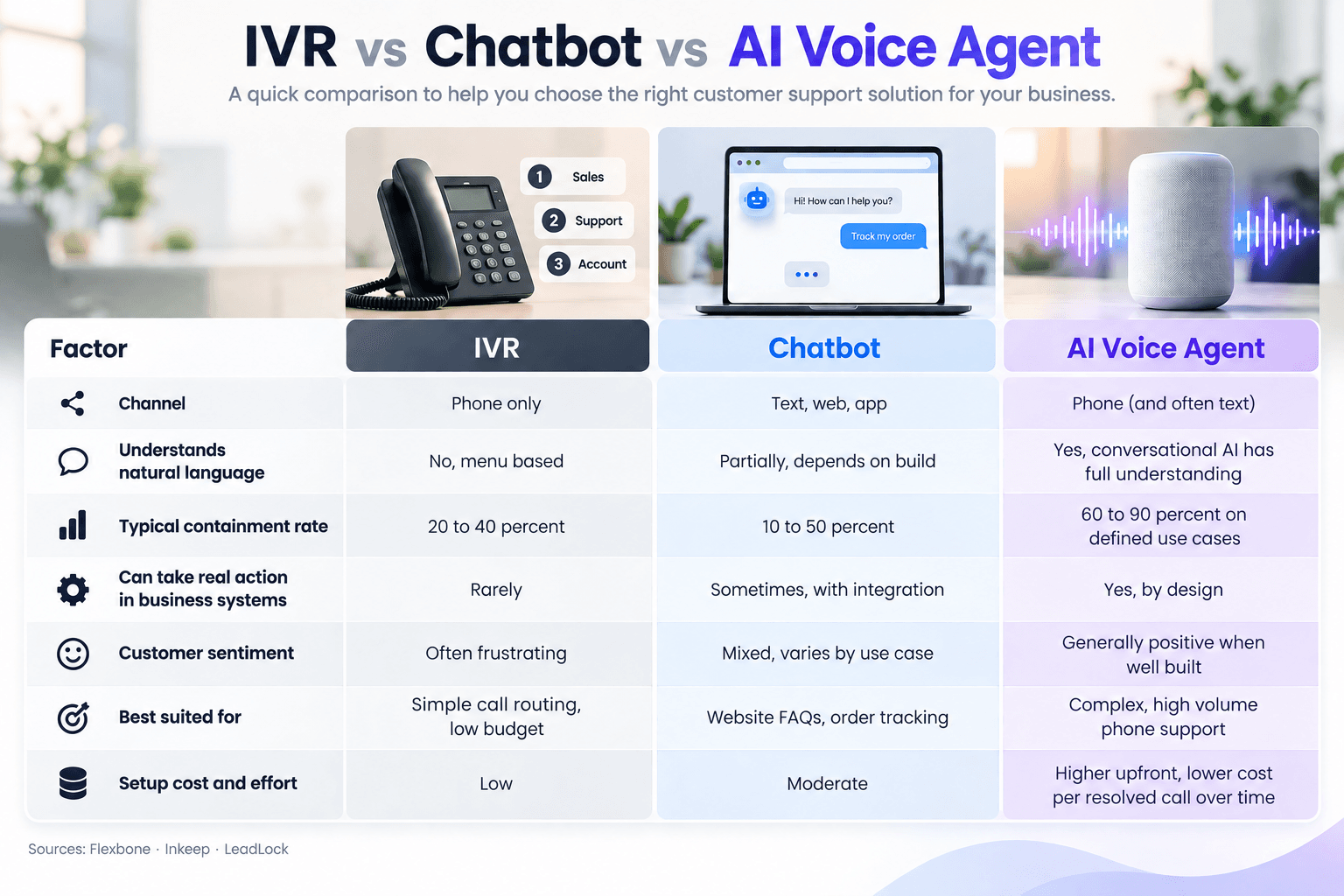
Step 3: Check what containment you can realistically expect - Industry benchmarks show basic IVRs contain 20 to 40 percent of calls when used purely for routing. Well built chatbots contain 10 to 30 percent of broad queries, rising to 30 percent for narrow, transactional ones.
Mature AI voice agents in regulated sectors such as banking have reported containment above 80 percent on routine queries, because they can both understand the request and complete the transaction.
Step 4: Test integration depth - Ask any vendor one direct question: can this system write back to my CRM, core banking platform, or ticketing tool in real time, or does it only read and display information? That single answer separates a glorified menu from a genuine AI voice agent.
Step 5: Decide your human handoff model - Good automation should know its limits and bring in a person with full context, not a blind transfer that makes the customer repeat everything.
Side by Side Comparison
What the Numbers Actually Tell Leaders
A few figures worth keeping in front of leadership:
- 51 percent of dissatisfied customers move away from the company completely after hitting an automated menu with no way out.
- 7 in 10 companies report IVR containment at 30 percent or below, meaning most calls reach a live agent anyway, after wasting the customer's time first.
- The global call centre AI market is growing at a 23.8 percent CAGR through 2030.
- Banks running well tuned AI voice agents for authenticated, routine queries have reported containment approaching 90 percent, far above basic IVR on the same call types.
The pattern is consistent. Rigid, button-based automation caps out quickly. Systems that understand language and can act on it keep climbing.
A Simple Decision Framework
Use this short checklist before choosing:
- Low budget, simple routes only, low call volume - An IVR may still be adequate.
- Mostly digital customers asking repetitive questions - A chatbot covers most needs.
- High call volume, complex requests, regulated industry, or a need to cut cost per contact on a scale - An AI voice agent is the stronger for long-term investment.
- You need all three channels working together - Look for a platform built to run voice and text through one reasoning layer, rather than three disconnected tools.
The Bottom Line
IVR, chatbots, and AI voice agents are not interchangeable, and picking based on price alone usually backfires once call volume grows.
Match the tool to the complexity of the conversation, the channel customers actually use, and how deeply it needs to reach into your business systems.
Contact centres are handling more customer calls while trying to control costs. This is where Voice native AI can make a difference. With the ability to understand customers, think through their requests, and access to business systems, voice AI is becoming an important part of modern customer service.
Natural voice agents like Clara AI are helping businesses move towards faster and more efficient customer support.
Frequently Asked Questions (FAQ)
Is an AI voice agent just a chatbot with a voice added on?
No. A chatbot with text to speech bolted on still follows scripted logic. A true AI voice agent reasons through the request and can execute actions, not just read a scripted reply.
Will an AI voice agent replace human agents entirely?
Unlikely, and that is not the goal. Strong deployments handle routine, high volume requests and hand off complex or sensitive ones to a human, with context carried over.
How long does it take to deploy an AI voice agent?
It depends on integration complexity, but most enterprise deployments move from pilot to production in weeks once core business systems are connected, not months.
Is IVR completely obsolete?
Not entirely. For very simple, low volume routing on a tight budget, a basic IVR can still make sense. It just should not be mistaken for a customer experience strategy.